نوروز 92 خجسته باد
هر روزتان نوروز
نوروزتان پیروز
Nowruz in English for other people who want to know about our
Nowruz celebration:
Happy Nowruz
| Significance | New year holiday |
|---|---|
| Date | March 20, 21 or 22 |
| 2012 date | Tuesday, March 20, 2012 at 05:14 UTC * |
| 2013 date | Wednesday 20 March 2013 at 11:02 UTC * |
A Haft sin table in Tehran.

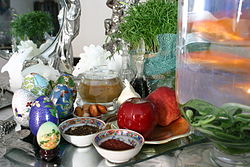
The "Haft Chin" items are:
Mirror – symbolizing Sky
- Apple – symbolizing Earth
- Candles – symbolizing Fire
- Golab – rose water symbolizing Water
- Sabzeh – wheat, or barley sprouts symbolizing Plants
- Goldfish – symbolizing Animals
- Painted Eggs – symbolizing Humans and Fertility
sabzeh – wheat, barley or lentil sprouts growing in a dish – symbolizing rebirthThe Haft Sīn items are:
- samanu – a sweet pudding made from wheat germ – symbolizing affluence
- senjed – the dried fruit of the oleaster tree – symbolizing love
- sīr – garlic – symbolizing medicine
- sīb – apples – symbolizing beauty and health
- somaq – sumac berries – symbolizing (the color of) sunrise
- serkeh – vinegar – symbolizing age and patience.
Other items on the table may include:
Sonbol – Hyacinth (plant)
- Sekkeh – Coins – representative of wealth
- traditional Iranian pastries such as baghlava, toot, naan-nokhodchi
- Aajeel – dried nuts, berries and raisins
- lit candles (enlightenment and happiness)
- a mirror (symbolizing cleanness and honesty)
- decorated eggs, sometimes one for each member of the family (fertility)
- a bowl of water with goldfish (life within life, and the sign of Pisces which the sun is leaving). As an essential object of the Nowruz table, this goldfish is also "very ancient and meaningful" and with Zoroastrian connection.[89]
- rosewater, believed to have magical cleansing powers
- the national colours, for a patriotic touch
- a holy book (e.g., the Avesta, Qur'an,or Kitáb-i-Aqdas) and/or a poetry book (almost always either the Shahnameh or the Divan ofHafiz)
Happy Nowruz
Nowruz is celebrated and observed
by Iranian peoples and the related cultural
continentand has spread in many other parts of the world, including parts of Central Asia,Caucasus, South Asia, Northwestern China, the Crimea and some groups in the Balkans.
Nowruz marks the first day of spring and the beginning of the year in the Iranian calendar. It is celebrated on the day of the astronomical Northward equinox, which usually occurs on March 21 or the previous/following day depending on where it is observed. As well as being a Zoroastrian holiday and having significance amongst the Zoroastrian ancestors of modern Iranians, it is also celebrated in parts of the South Asian sub-continent as the New Year. The moment the Sun crosses the celestial equator and equalizes night and day is calculated exactly every year and Iranian families gather together to observe the rituals.
Originally being a Zoroastrian festival, and the holiest of them all, Nowruz is believed to have been invented by Zoroaster himself, although there is no clear date of origin. Since the Achaemenid era the official year has begun with the New Day when the Sun leaves thezodiac of Pisces and enters the zodiacal sign of Aries, signifying the Spring Equinox. Nowruz is also a holy day for Sufis, Ismailis, Alawites, Alevis, Babis and adherents of the Bahá'í Faith.
The term Nowruz in writing first appeared in Persian records in the 2nd century AD, but it was also an important day during the time of the Achaemenids c. 548–330 BC), where kings from different nations under the Persian empire used to bring gifts to the Emperor, also called King of Kings (Shahanshah), of Persia on Nowruz. The significance of Nowruz in the Achaemenid empire was such that the great Persian king Cambyses II's appointment as the king of Babylon was legitimized only after his participation in the New Year festival (Nowruz).
Nowruz celebration in Iran
 Happy Nowruz
Spring cleaning and visiting one another
Spring cleaning, or Khouneh Tekouni (literally means 'shaking the house') or 'complete cleaning of the house' is commonly performed before Nowruz. Persians and other Indo-Iranian groups (Kurds, Azarbaijanis and Balochs) start preparing for the Nowruz with a major spring-cleaning of their houses, the purchase of new clothes to wear for the new year and the purchase of flowers (in particular thehyacinth and the tulip are popular and conspicuous).
In association with the "rebirth of nature", extensive spring-cleaning is a national tradition observed by almost every household in Iran. This is also extended to personal attire, and it is customary to buy at least one set of new clothes. On the New Year's Day, families dress in their new clothes and start the twelve-day celebrations by visiting the elders of their family, then the rest of their family and finally their friends. On the thirteenth day families leave their homes and picnic outdoors.
During the Nowruz holidays, people are expected to visit one another (mostly limited to families, friends and neighbors) in the form of short house visits, which are usually reciprocated. Typically, on the first day of Nowruz, family members gather around the table, with the Haft Seen on the table or set next to it, and await the exact moment of the arrival of the spring. At that time gifts are exchanged. Later in the day, the first house visits are paid to the most senior family members. Typically, the youth will visit the elders first, and the elders return their visit later. When in previous year, a family member is deceased, the tradition is to visit that family first (among the elders). The visits naturally have to be relatively short, otherwise one will not be able to visit everybody on their list. A typical visit is around 30 minutes, where you often run into other visiting relatives and friends who happen to be paying a visit to the same house at that time. Because of the house visits, you make sure you have a sufficient supply of pastry, cookies, fresh and dried fruits and special nuts on hand, as you typically serve your visitors with these items with tea or sherbet. Many Iranians will throw large Nowruz parties in a central location as a way of dealing with the long distances between groups of friends and family.
Some Nowruz celebrants believe that whatever a person does on Nowruz will affect the rest of the year. So, if a person is warm and kind to their relatives, friends and neighbors on Nowruz, then the new year will be a good one. On the other hand, if there are fights and disagreements, the year will be a bad one. As an extended tradition to the holiday, men may or may not choose to shave their faces until the night of the "New Day" as a sign of removal of old habits and tendencies and the rebirth of their faith and being.
One tradition that may not be very widespread (that is, it may belong to only a few families) is to place something sweet, such as honey or candy, in a safe place outside overnight. On the first morning of the new year, the first person up brings the sweet stuff into the house as another means of attaining a good new year.
| Also called | Also spelled Nouruz, Norouz, Norooz, Narooz, Nawru, Nauruz, Nawroz, Noruz, Nohrooz, Novruz, Nauroz, Navroz, Naw-Rúz, Nowroj, Navroj, Nevruz, Newroz, Navruz, Navrez, Nooruz, Nauryz, Nevruz, Nowrouz,Наврӯз, ნავრუზი (Georgian), नवरेह (Kashmiri), નવરોઝ (Parsi Gujarati) |
|---|
| Significance | New year holiday |
|---|---|
| Date | March 20, 21 or 22 |
| 2012 date | Tuesday, March 20, 2012 at 05:14 UTC * |
| 2013 date | Wednesday 20 March 2013 at 11:02 UTC * |
So Happy Nowruz
Happy Nowruz
*
Happy Nowruz
Happy Nowruz
 خدایا توفیقم ده که بیش از طلب همدلی، همدلی کنم.